In our earlier guides on anemia, we talked about how red blood cells act like tiny “oxygen taxis” delivering energy across your body. Usually, anemia happens when those taxis run low on fuel (like in iron deficiency) or get built in the wrong shape (like in sickle cell anemia).
But what happens when the entire blood factory itself suddenly shuts down?
That is what happens in Aplastic Anemia. It is a rare, serious blood condition—and despite having the word “anemia” in its name, it affects much more than just your red blood cells. Today, we will break down what happens inside your bone marrow, the three red flags to watch for, and why modern treatments give patients real hope.
Table of Contents
What Exactly is Aplastic Anemia?
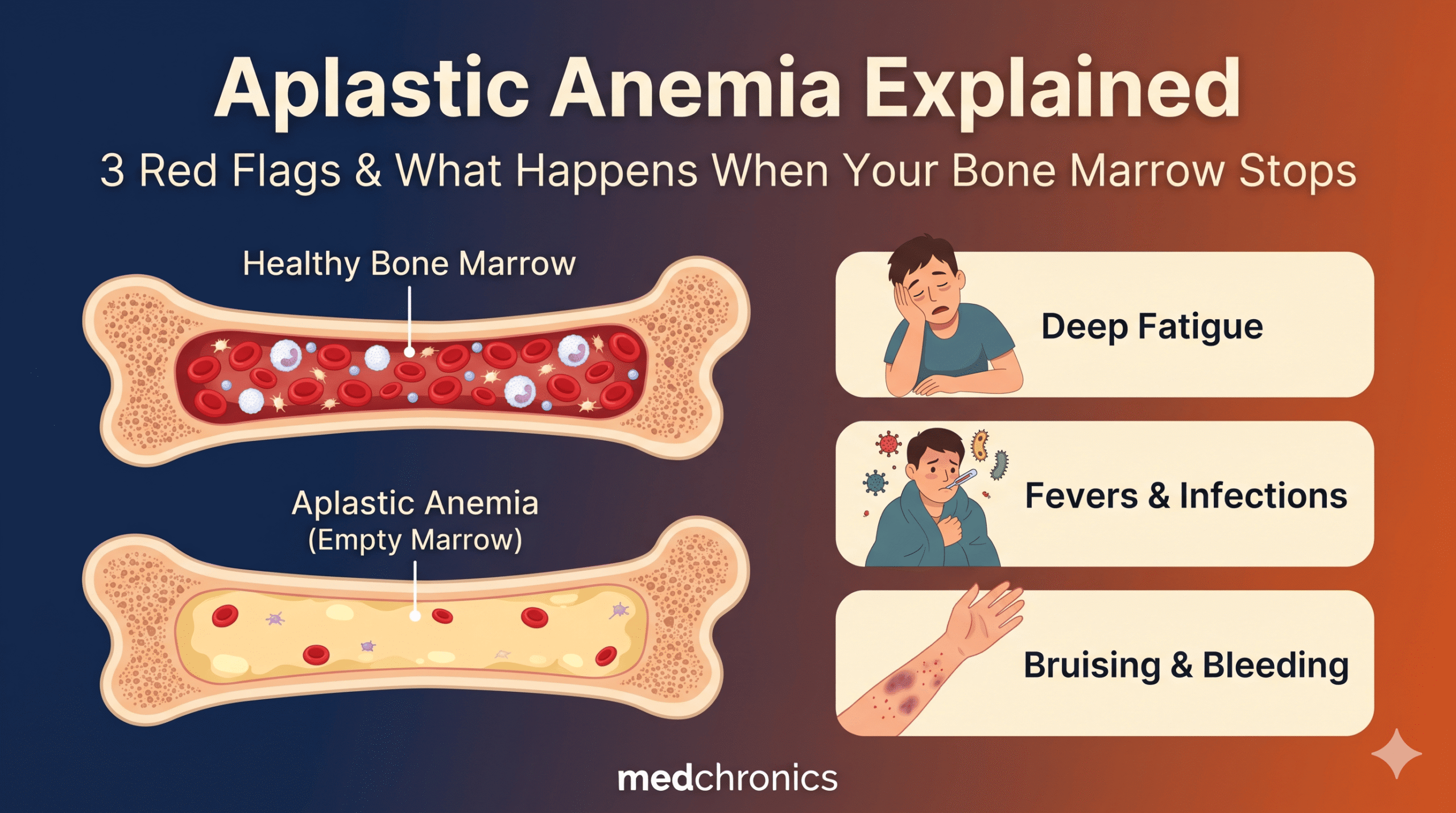
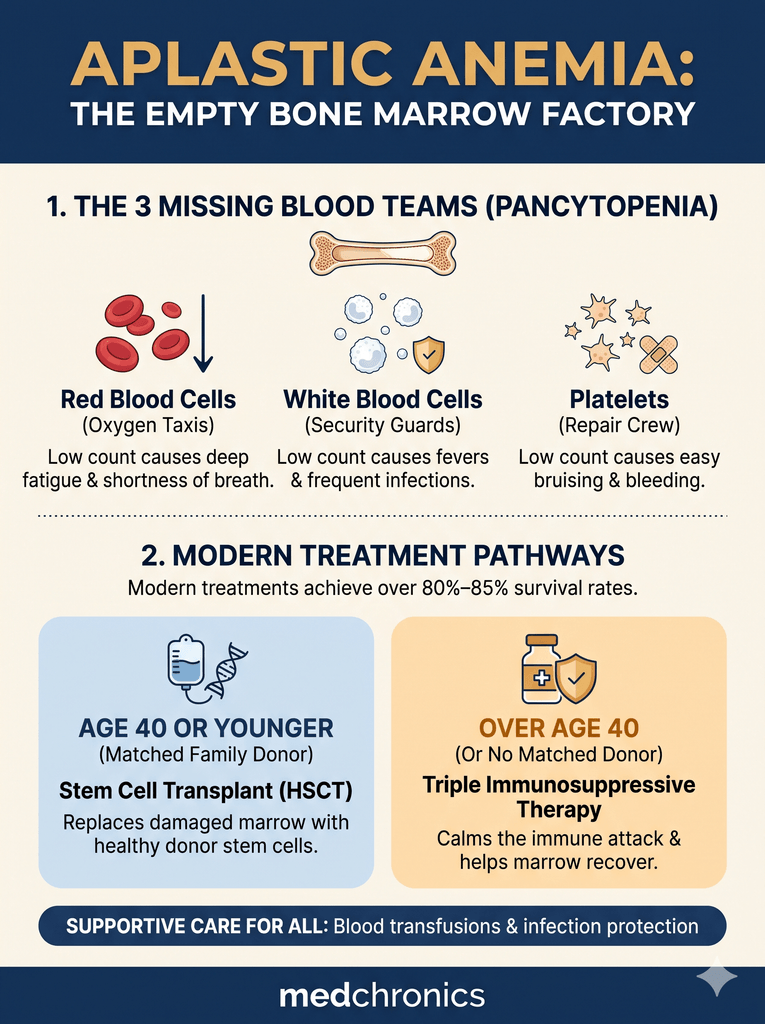
Deep inside the hollow center of your bones sits a soft, spongy factory called the bone marrow. Every single day, special “master cells” (called stem cells) inside this factory build three essential worker teams for your bloodstream:
- Red Blood Cells (The Oxygen Taxis): They carry fresh oxygen from your lungs to your muscles and brain.
- White Blood Cells (The Security Guards): They patrol your body and fight off germs and infections.
- Platelets (The Repair Crew): They rush to cuts and scrapes to clot your blood and stop bleeding.
In aplastic anemia, the bone marrow factory fails to keep up production. Instead of only losing oxygen taxis, your body runs dangerously low on all three teams at the same time—a state doctors call pancytopenia, as outlined in a 2025 StatPearls clinical review.
Why Does the Factory Shut Down?
Hearing that your bone marrow has slowed down naturally brings up one big question: What caused this?
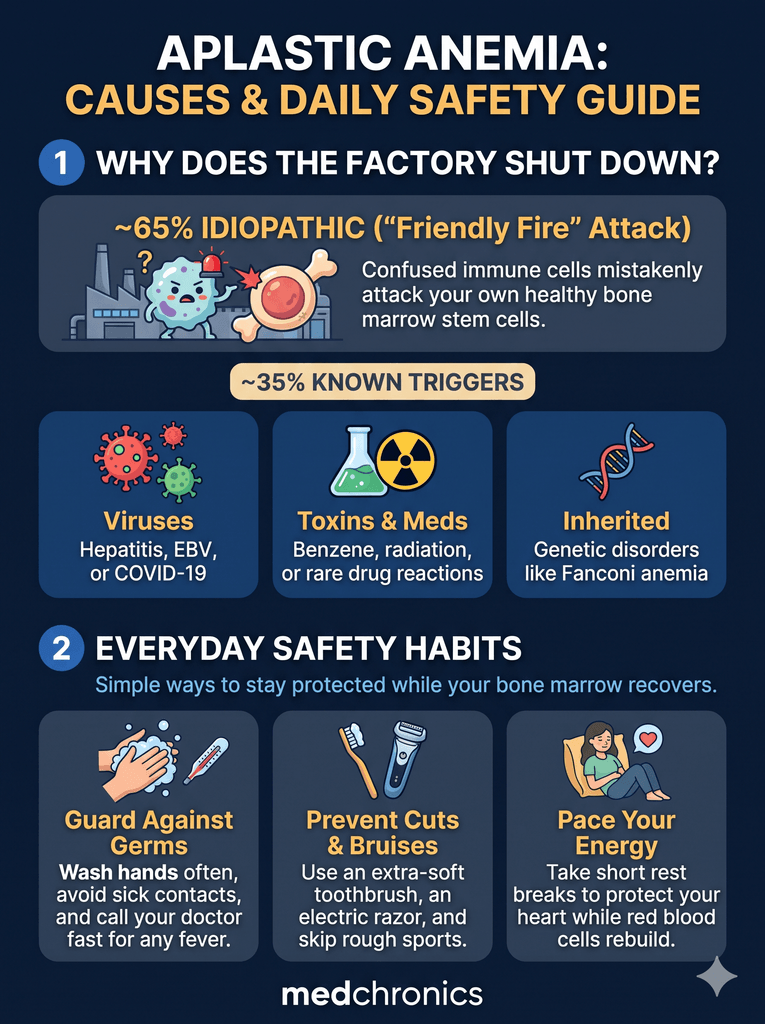
According to research published via NCBI StatPearls, roughly 65% of aplastic anemia cases are “idiopathic,” meaning doctors cannot pinpoint one single outside trigger. However, scientists do understand how the damage usually happens inside the body.
The “Friendly Fire” Immune Attack
In most cases, the problem is an accidental case of friendly fire. Your body’s own immune cells (specifically T-helper cells) get confused and mistake your healthy bone marrow stem cells for dangerous invaders. They release harsh inflammatory chemical signals (such as IFN-gamma and TNF) that force your blood-making stem cells to self-destruct. In some people, built-in weaknesses in the stem cells themselves (such as shortened protective caps called telomeres) also play a role.
Known Triggers and Rare Causes
For the remaining 35% of cases, doctors can often trace the factory shutdown back to specific triggers:
- Viral Infections: Certain viruses—including hepatitis, Epstein-Barr virus (EBV), and COVID-19—can sometimes confuse the immune system into attacking the marrow.
- Toxic Exposures: Heavy contact with harsh industrial chemicals like benzene, high-dose radiation, or rare reactions to specific medications can damage the marrow factory.
- Inherited Conditions: A smaller number of people are born with genetic bone marrow disorders, the most common being Fanconi anemia.
3 Red Flags You Should Never Ignore
Because all three blood cell teams drop together, aplastic anemia sends out three distinct warning signals. Symptoms can appear slowly over weeks or hit quite suddenly.
1. Deep Fatigue and Shortness of Breath (Missing Oxygen Taxis)
When your red blood cell count drops, your muscles and heart have to work overtime just to get basic oxygen. Simple tasks like climbing stairs or walking to another room can leave you completely wiped out, dizzy, pale, and gasping for air.
2. Frequent Fevers and Stubborn Infections (Missing Security Guards)
Without enough infection-fighting white blood cells (especially neutrophils), everyday germs become a real threat. Patients often develop sudden, unexplained fevers or catch repeated infections that linger much longer than normal.
3. Easy Bruising, Tiny Red Dots, and Unusual Bleeding (Missing Repair Crew)
When your platelet repair crew is missing, even tiny bumps leave large dark bruises. You might also notice nosebleeds, bleeding gums when brushing your teeth, or clusters of tiny, flat red or purple pinpoint dots on your skin called petechiae.
A Key Clue Doctors Look For: Unlike some blood cancers or swollen-gland disorders, aplastic anemia usually does not cause your liver, spleen, or lymph nodes to swell up. Your body’s factory is simply quiet, not overcrowded.
How Do Doctors Confirm Aplastic Anemia?
Because fatigue and bruising can happen for many reasons, doctors rely on two main steps to be 100% sure:
- Complete Blood Tests: Doctors check whether at least two of your blood cell teams have dropped below severe safety thresholds—such as brand-new red cells (reticulocytes) falling below 40,000/µL (or under 1%), infection-fighting neutrophils (ANC) dropping below 500/µL, or platelets sinking below 20,000/µL (Nimmana & Penney, 2025).
- Bone Marrow Biopsy: This is the gold-standard test that confirms the diagnosis. A doctor takes a tiny sample from the hip bone and looks at it under a microscope. In aplastic anemia, the normally busy factory floor looks mostly empty and filled with fat cells instead—with no cancer cells or scar tissue blocking the space.
How is Aplastic Anemia Treated? (And Is There Hope?)
Years ago, aplastic anemia was extremely hard to treat and carried a very high risk if left untreated. Today, the outlook has changed dramatically. Thanks to modern medical care, survival rates now exceed 80% to 85%, according to 2025 clinical data from StatPearls.
Doctors choose the best treatment path based mainly on a patient’s age and whether a matched family donor is available:
| Patient Profile | Primary Modern Treatment | How It Works Simply |
| Age 40 or Younger (with a matched related donor) | Bone Marrow / Stem Cell Transplant (HSCT) | Replaces the damaged factory with healthy, working stem cells from a matched sibling or relative. |
| Over Age 40 (or no matched related donor) | Triple Immunosuppressive Therapy (IST) | Uses a 3-medicine team (horse ATG, cyclosporine, and eltrombopag) to calm the immune attack and jump-start marrow growth. |
| All Patients (During Recovery) | Supportive Care | Blood and platelet transfusions to boost counts safely, preventive medicines against germs, and fast treatment if a fever spikes. |
Everyday Safety Habits While Managing Recovery
Medical treatment does the heavy lifting, but smart daily habits help protect your body while your bone marrow factory rebuilds its teams:
- Guard Against Germs: Wash your hands often, avoid close contact with people who have active colds or flu, and call your doctor immediately if you develop a fever.
- Prevent Cuts and Bruises: Switch to an extra-soft toothbrush, use an electric razor instead of blades, and skip rough contact sports while platelet counts are low.
- Pace Your Energy: Listen to your body when fatigue hits—short rest breaks prevent you from over-straining your heart while red cell counts recover.
Aplastic anemia sounds frightening at first, especially when you hear the words “bone marrow failure.” But recognizing the three red flags early and getting tested by a hematologist opens the door to highly effective treatments that help most patients get their factory—and their lives—back on track.
Frequently Asked Questions
Q: Is aplastic anemia a type of cancer?
No. Aplastic anemia is not cancer. Unlike leukemia, where abnormal cancer cells overcrowd the bone marrow, aplastic anemia happens when the bone marrow becomes empty and stops producing enough healthy blood cells.
Q: Can you fix aplastic anemia by eating iron-rich foods or taking iron pills?
No. While a healthy diet supports overall recovery, aplastic anemia is not caused by a lack of iron in your food. Because the problem is usually an immune attack on the bone marrow factory itself, it requires specialized medical treatment like immunosuppressive medicines or a stem cell transplant.
Q: Is aplastic anemia contagious?
No, you cannot catch aplastic anemia from another person. Even when a past virus triggers an immune reaction, the bone marrow failure itself cannot spread from person to person.
Q: Can people survive aplastic anemia today?
Yes. While untreated severe aplastic anemia is dangerous, modern treatments—specifically stem cell transplants and triple immunosuppressive therapy—have boosted survival rates to over 80%–85%.
Medical References (1 Source)
1. Nimmana BK, Penney SW. Aplastic Anemia. [Updated 2025 Jul 7]. In: StatPearls [Internet]. Treasure Island (FL): StatPearls Publishing; 2025 Jan-. Available from: NCBI Bookshelf (PMID: 30480951).