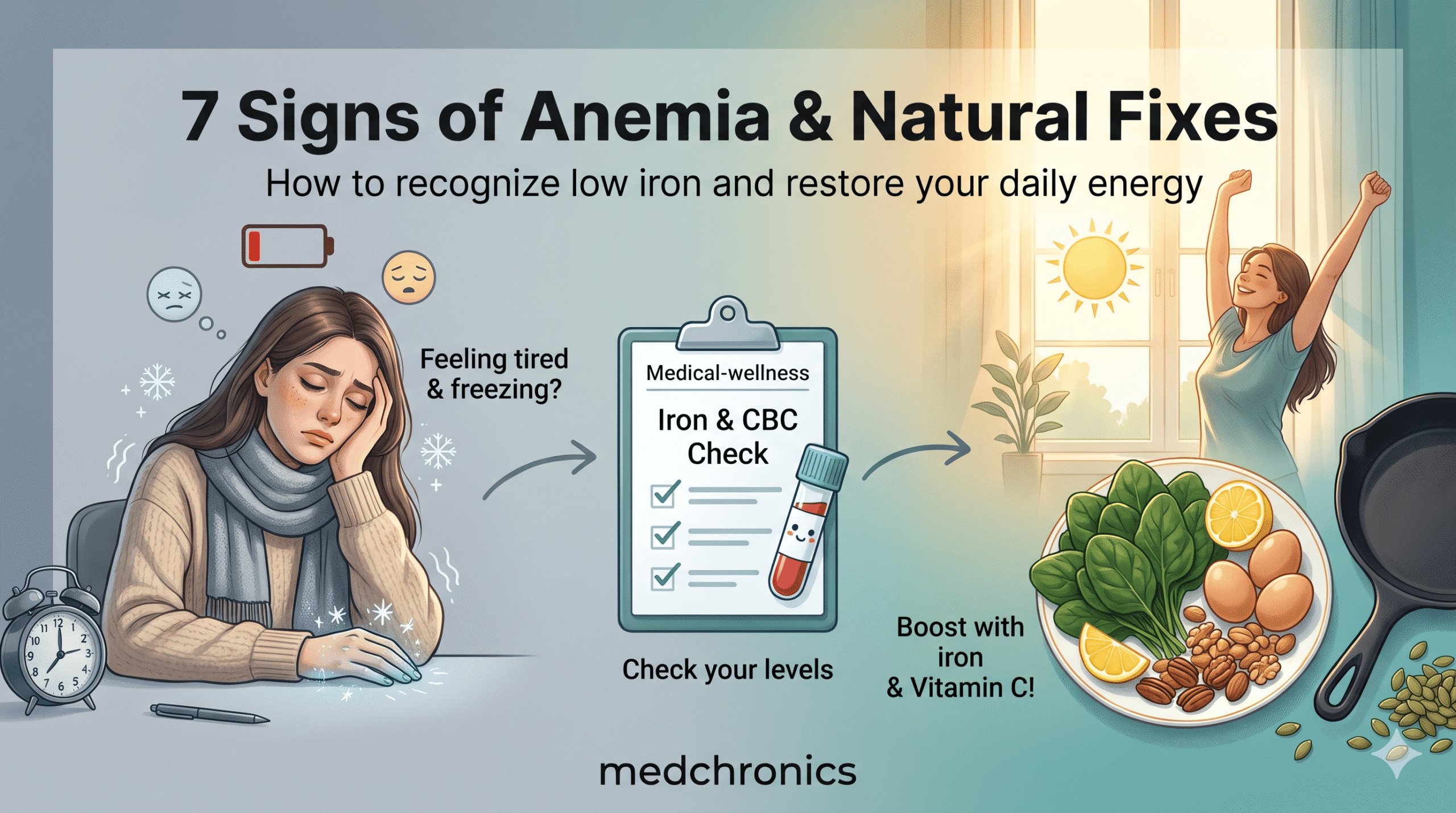
Imagine your body as a busy city and your red blood cells as millions of tiny delivery trucks.
Every single second, these little trucks travel through your body. Their only job is to pick up fresh oxygen from your lungs and deliver it to your brain, heart, and muscles. But what happens if half of your delivery trucks suddenly break down?
Your city starts to slow down. The lights grow dim, and everything feels much harder to do. This frustrating slowdown is exactly what happens when you have a condition called anemia.
If you have been feeling exhausted, freezing cold, or just “off” lately, your body might be trying to send you a message. Today, we are going to explore the 7 silent signs of anemia. We will also learn exactly how to repair your delivery trucks using simple, natural fixes.
Table of Contents
What Exactly is Anemia? (The Simple Science)
To understand the signs of anemia, we need to understand a very special protein called hemoglobin.
Think of hemoglobin as the seats inside your red blood cell “delivery trucks.” Oxygen sits in these seats to travel around your body. To build these seats, your body needs a very important mineral: iron.
If you do not eat enough iron, your body cannot build hemoglobin. Without hemoglobin, the oxygen has nowhere to sit. This means your brain and muscles do not get the fresh air they need to survive and thrive.
When your body lacks healthy red blood cells, doctors call this anemia. The most common type in the world is caused by low iron. According to the World Health Organization (WHO), millions of people have low iron without even realizing it!
7 Silent Signs of Anemia You Shouldn’t Ignore
Because the symptoms develop very slowly, many people ignore them for months. Here are the 7 warning signs of anemia that mean your body desperately needs more oxygen.
1. Crushing Exhaustion (Not Just Normal Tiredness)
We all get tired after a long day of work or school. But anemia fatigue is completely different.
It is a heavy, crushing exhaustion that does not go away, even after you sleep for nine whole hours. You might wake up feeling like you just ran a marathon.
Why does this happen? due to the fact that your muscles are literally in need of oxygen. Without enough oxygen, your body cannot create basic physical energy. If your daily tiredness feels like a heavy backpack you cannot take off, it is one of the biggest signs of anemia.
2. Freezing Hands and Feet
Do you wear thick wool socks to bed, even in the summertime? Are your fingers always icy cold?
Your body is incredibly smart. When you have low iron and a shortage of oxygen, your brain has to make a tough choice. It decides to send all the available oxygen to your most important organs, like your heart and your brain.
Because of this, your hands and feet (which are furthest away from your heart) get left out. The lack of warm, oxygen-rich blood flow leaves your fingers and toes feeling like ice cubes.
3. Dizziness and Brain Fog
Have you ever stood up too quickly and felt the room spin for a few seconds?
While this happens to everyone occasionally, doing it constantly is a major red flag. Your brain needs a massive amount of oxygen to think clearly. When you have anemia, your brain simply does not get enough fuel.
This leads to feeling dizzy, lightheaded, and struggling to focus on your work. This mental cloudiness is often called “brain fog.” Many people confuse this with a lack of sleep, but it is actually one of the clearest signs of anemia.
4. Pale or Yellowish Skin
Take a quick look at the inside of your lower eyelids or your gums. Are they a bright, healthy pink, or do they look completely pale?
Red blood cells get their bright red color from iron. When your body is running on low iron, your blood actually becomes less red. This causes your skin to lose its natural, healthy glow.
You might notice that your face, the inside of your lips, or your fingernail beds look unusually pale, washed out, or even slightly yellowish.
5. Shortness of Breath on the Stairs
Imagine walking up a single flight of stairs in your house. Usually, you don’t even think about doing this.
But if you have anemia, reaching the top step might leave you gasping for air. Your heart starts pounding loudly in your chest.
This happens because your lungs are desperately trying to pull in more oxygen to make up for the lack of delivery trucks. Your heart has to beat twice as fast to pump whatever little oxygen you have left. Shortness of breath during easy activities is one of the most common signs of anemia.
6. Strange Cravings (Ice or Dirt)
This is one of the strangest, yet most fascinating, signs of low iron.
When your body is severely lacking minerals, it can trigger a condition called “Pica.” Pica causes you to intensely crave things that are not actually food. Those who are affected by anemia frequently have a strong desire for chewing on ice cubes. Some people even crave eating dirt, clay, or paper! If you are constantly crunching on ice all day long, your body is begging for an iron refill.
7. Brittle Nails and Hair Loss
Your body considers your hair and nails to be “extra” features. They are not necessary to keep you alive.
When your body is in an emergency state due to low iron, it stops sending nutrients to your hair follicles and nail beds.
You might notice that your fingernails become very thin, flat, and break easily. In severe cases, they might even curve upwards like a tiny spoon. You may also notice a lot more hair falling out in the shower drain than usual.
Natural Fixes: How to Boost Your Iron Levels
If you are experiencing these signs of anemia, do not panic! In most cases, mild low iron is highly reversible. You just need to give your body the raw materials it needs to build more delivery trucks.
Here are the best, science-backed natural fixes to rebuild your blood:
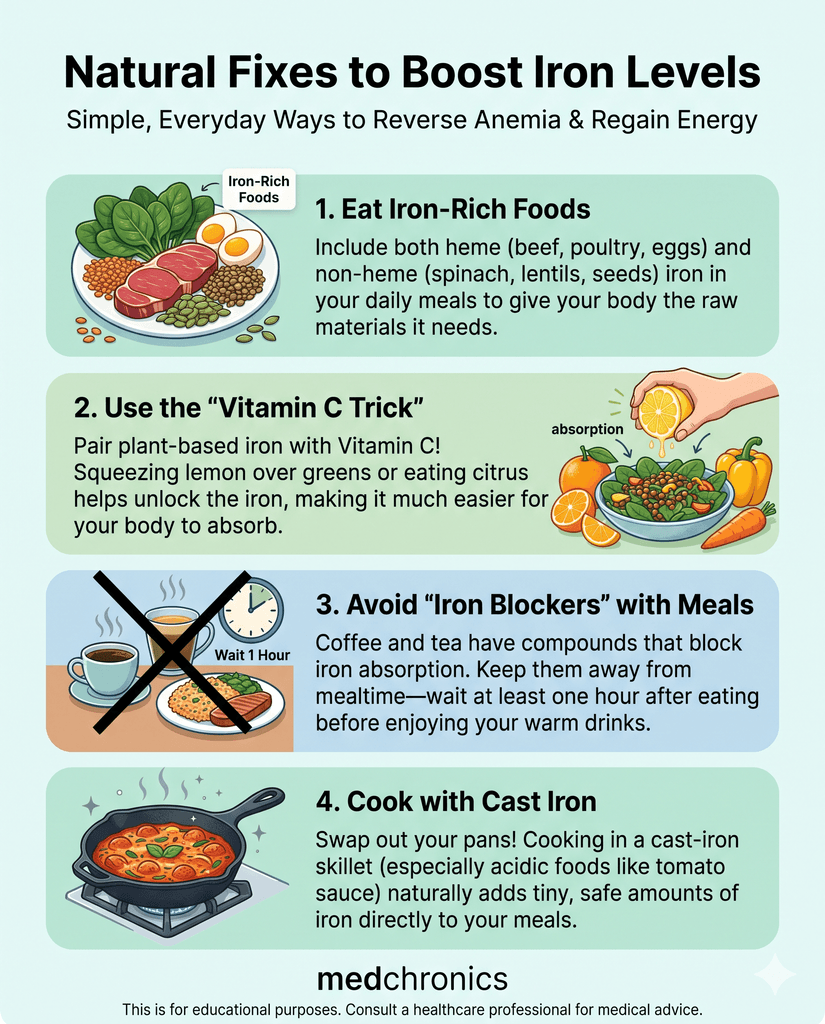
Eat More Iron-Rich Foods
- There are two types of iron found in food. Your body needs both to recover fully.
- Heme Iron (Fastest to Absorb): Found in animal products. The best sources are lean red meat, chicken liver, turkey, and eggs. Your body absorbs this type very easily.
- Non-Heme Iron (Plant-Based): Found in dark green leafy vegetables. The best sources are spinach, kale, lentils, chickpeas, and pumpkin seeds.
Use the “Vitamin C Trick”
- If you are eating plant-based iron (like a spinach salad), your body struggles to absorb it all. You can unlock this iron by pairing it with Vitamin C!
- The Fix: Squeeze fresh lemon juice over your spinach salad. Drink a small glass of orange juice with your morning eggs. Add sweet bell peppers to your lentils. Vitamin C acts like a key that unlocks iron and pulls it directly into your bloodstream.
Avoid the “Iron Blockers”
- Did you know that some of your favorite morning drinks are actually stealing your iron?
- Coffee and black tea contain compounds called tannins and polyphenols. These act like a shield, blocking your body from absorbing iron from your food.
- The Fix: Never drink coffee or tea during your meals. Wait at least one full hour after eating before you enjoy your warm drinks. (If you want to learn more about how your digestion affects nutrient absorption, check out our guide on Gut Health: Stop Silent Damage).
Cook with Cast Iron
- Swapping out your normal cooking pans for a heavy cast-iron skillet is a brilliant, old-fashioned trick. When you cook acidic foods (like tomato sauce) in a cast-iron pan, tiny, safe amounts of iron naturally flake off into your meal, giving you a hidden health boost!
When Should You See a Doctor?
While eating healthy foods is amazing for your body, you should never try to diagnose yourself.
If you recognize multiple signs of anemia from this list, it is time to visit your healthcare provider. They will perform a simple, quick blood test called a CBC (Complete Blood Count).
This test will show exactly how many red blood cells you have. If your levels are critically low, your doctor might prescribe a high-quality iron supplement to help you recover much faster than food alone.
Feeling constantly exhausted, dizzy, and freezing cold can make daily life incredibly frustrating. But remember, your body is just asking for a little bit of help.
By paying attention to these early signs of anemia and eating a diet rich in iron and Vitamin C, you can rebuild your red blood cells. Soon, your body’s “delivery trucks” will be back on the road, and you will finally regain the bright, warm energy you deserve!
Frequently Asked Questions (FAQs)
Q: What are the very first signs of anemia?
The earliest signs are usually unexplained fatigue and feeling cold. Long before you feel dizzy or notice pale skin, your body will simply feel heavier and more tired than usual.
Q: Can stress cause signs of anemia?
Directly, no. However, chronic stress (like High Cortisol) can harm your digestion. If your gut is stressed, it cannot absorb iron properly from your food, which can eventually lead to low iron levels.
Q: How long does it take to fix low iron naturally?
Rebuilding red blood cells takes time. Even if you eat perfectly and take supplements, it usually takes about 3 to 6 weeks to start feeling energetic again.
Q: Are bananas good for anemia?
Bananas are excellent for your overall health, but they are not very high in iron. However, they do contain Vitamin C and folic acid, which help support healthy blood production.
Q: Is drinking milk bad for iron absorption?
Yes. Calcium can block your body from absorbing iron. Try to avoid drinking large glasses of milk right when you eat your iron-rich meals.