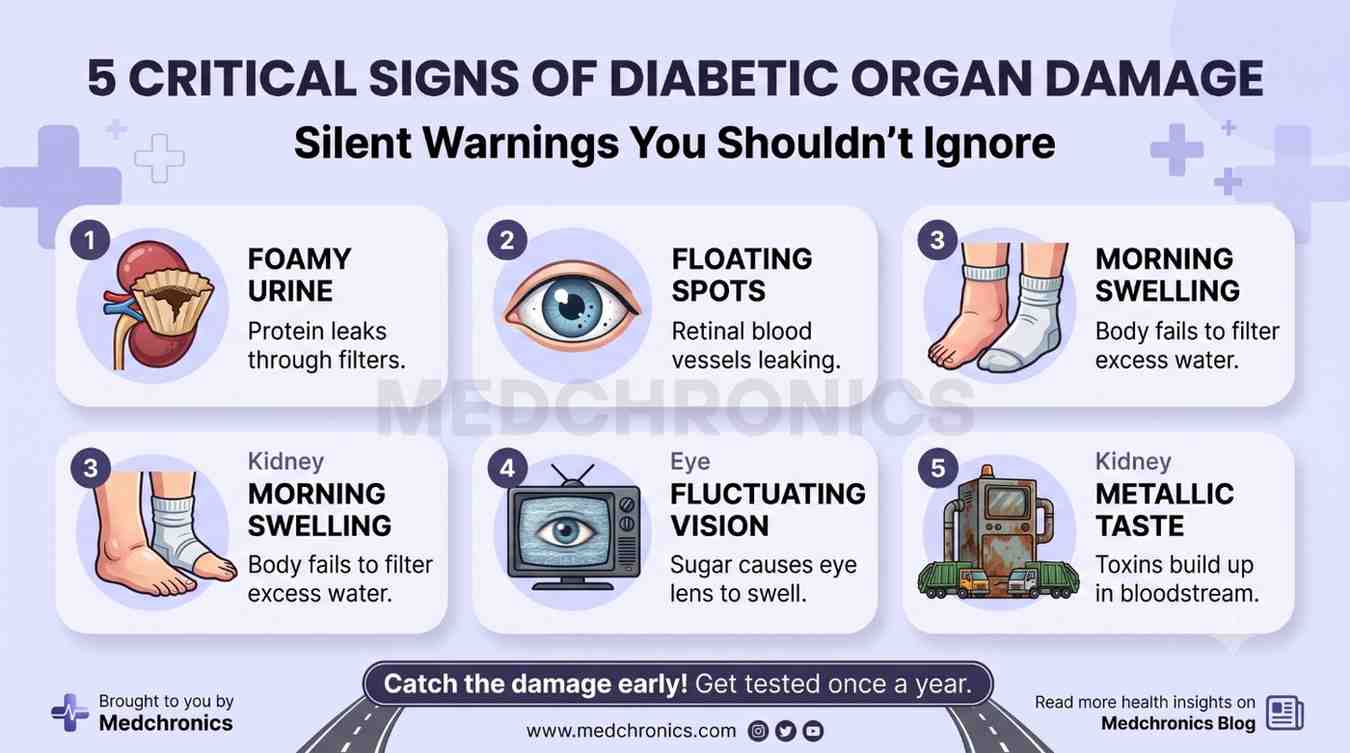
Did you know the 5 critical signs of diabetic organ damage? This means the real danger of diabetes is not just high sugar, but the silent damage it causes inside your body. If you ignore regular checkups, your kidneys and eyes can slowly get damaged without causing you a single drop of pain.
Imagine your body is like a big, beautiful, and bustling city. The nutrients are the cars moving around, the heart is the central power station, and the roads are your blood vessels.
In this city, Sugar is a worker. In normal amounts, Sugar is great because it visits every house, shop, and office to give energy to the town. But when the streets get overcrowded, Sugar molecules start bumping into walls, scratching the paint off buildings, and blocking the narrow streets.
In diabetic organ damage, the worst part? They do this so quietly that the city mayor (your brain) doesn’t realize the damage until it becomes a big crisis. Doctors call this Silent Damage because it happens without a warning bell.
Two of the most delicate areas in this “body city” are the Kidneys (the water-purification factory) and the Eyes (the high-tech camera department). Let’s explore the 5 critical warning signs of diabetic organ damage that tell us Sugar is causing trouble inside, using simple stories to see exactly what is happening under the hood.
Table of Contents
1. The Foamy Water: Foamy Urine
Think of your kidneys as a super-smart coffee filter that cleans your blood every single minute of the day. Its main job is highly specific: it keeps the good things, like proteins, inside your body while flushing the waste liquids out into the toilet. Proteins are the precious building blocks for your muscles, skin, and bones, so the body wants to keep every single piece.
When too much Sugar crowds the kitchen, it stops acting like a helpful worker and starts acting like sharp pieces of rough sand. As this sugary sand rushes through the delicate paper coffee filter day after day, it scratches the surface and pokes tiny holes in it.
Suddenly, the filter gets torn. The precious proteins, which are supposed to stay in your blood, start slipping through these new holes and falling into your urine. Doctors call this early stage of leaking protein Microalbuminuria.
How to Spot It
Think of what happens when you pour liquid soap into water and stir it up—it creates a thick, stubborn layer of bubbles that doesn’t just go away.
The Warning Sign
If your urine looks unusually foamy or bubbly day after day, and those bubbles stay in the toilet bowl long after you are done, your kidney filter is crying for help. It is a visible sign that your water-purification plant has a leak and is accidentally throwing away your body’s building blocks.
2. The Leaky Pipes: Morning Swelling
Because the kidney filters are getting damaged by the high sugar traffic in diabetic organ damage, the factory workers get completely confused. They lose their ability to manage the city’s hydration system and forget how to balance water levels. Instead of pumping out the extra fluid and salt through the waste pipes, they leave them sitting inside your system.
Imagine a pipe slowly leaking water beneath your living room carpet. For the first few hours, you might not notice anything wrong. But gradually, the water collects under the surface, the carpet becomes soggy, and the floor visibly puffs up.
In your body, gravity pulls this extra water down to your feet during the day when you are walking around. But when you lie flat at night to sleep, that water travels easily across the flat plains of your body, settling around your face and eyes.
How to Spot It (Morning)
When you wake up first thing in the morning, look closely in the mirror before you do anything else. Do your eyelids look heavy, puffy, and swollen? This facial fluid accumulation is a clear indicator that your body couldn’t clear out the night-time fluid build-up in diabetic organ damage.
How to Spot It (Evening)
By the evening, check the lower half of your body. Do your shoes feel tight and uncomfortable even though they fit fine in the morning? When you pull down your socks, do they leave deep, red, tight rings pressed into your ankles that take a long time to disappear? This fluid backup means your kidneys are struggling to clear out the excess water.
3. The Dusty Camera Lens: Floating Dark Spots
At the very back of your eye, there is a marvellous screen called the Retina. This screen works like a high-tech wall display made of millions of tiny, glowing fairy lights that capture the world around you and send pictures to your brain. To stay bright and healthy, these fairy lights need constant power through very thin electrical wires, which are your microscopic blood vessels.
When excess Sugar rushes through these fragile wires, it causes the tiny walls to stretch, swell, and weaken in diabetic organ damage. Eventually, the pressure becomes too much, and the vessels start to leak tiny drops of blood directly onto the glowing fairy lights. Medical professionals call this condition Diabetic Retinopathy.
How to Spot It
Imagine someone sprayed a few tiny drops of dark ink or paint onto your camera lens. No matter how much you wipe the front glass, the dark spots stay in the picture of diabetic organ damage.
The Warning Sign
When looking at a plain white wall or a clear blue sky, you might see tiny black dots, squiggly lines, or cobweb-like shapes drifting across your vision. These are called floaters. They actually drift and glide whenever you move your eyes to look somewhere else. These floaters are the actual physical shadows of tiny blood droplets inside your eye casting a shadow on your screen, showing that the camera department is under attack.
4. The Flickering Screen: Blurry Vision That Comes and Goes
Have you ever tried to watch a movie on a screen when the electricity voltage in the house is constantly fluctuating? The picture goes bright, then dark, then completely fuzzy, and then suddenly snaps back to being crystal clear. It is incredibly frustrating because you can’t focus on the story.
When your blood sugar levels behave like a wild roller coaster—shooting sky-high after a heavy, sweet meal and dropping down a few hours later—water actually enters and exits the lens of your eye. Your eye’s lens is a transparent structure that helps you focus by bending light. When sugar is high, the lens acts like a sponge, pulling in water and swelling up. When sugar drops, the water rushes out, and the lens shrinks back down.
How to Spot It
This creates a very confusing game of hide-and-seek with your eyesight in diabetic organ damage. One day, you can read a book or a phone screen perfectly fine without any help. The next afternoon, the words look completely blurry, and you find yourself holding the screen far away or squinting to read.
The Reality Check
If your vision is changing back and forth from morning to night, it is usually not a permanent eye problem yet. It is just the fluctuating sugar levels physically changing the shape and thickness of your eye lens, making the camera focus slide back and forth.
5. The Toxic Buildup: Metallic Taste and Constant Fatigue
When your water-purification factory slows down drastically because of long-term sugar damage, the city’s trash trucks stop running entirely. The waste products, chemicals, and toxins that should be thrown out in the garbage start backing up into the main highways, circulating in your blood.
Imagine leaving the kitchen garbage bins inside your house for weeks without ever taking them outside to the big dumpster. Very quickly, the house begins to smell bad, the air feels heavy, you feel sick to your stomach, and you lose your appetite to eat your favorite foods.
The Taste
Because of these built-up toxins circulating through your bloodstream, you might wake up with a strange, bitter, or metallic taste in your mouth. It feels exactly like you’ve been chewing on a rusty iron coin or licking an old metal key, and no amount of toothpaste or mouthwash seems to clear it away.
The Feeling
Along with the bad taste, you will notice a deep, heavy, and unbreakable exhaustion. Because your internal systems are working ten times harder just to deal with the internal trash buildup and chemical imbalance, you feel completely drained of energy. You can sleep for 8 or 9 hours straight, but the moment you open your eyes, you still feel like you haven’t rested a single minute.
The Secret Shield to Protect Organ Damage: Catch It Before It Breaks!
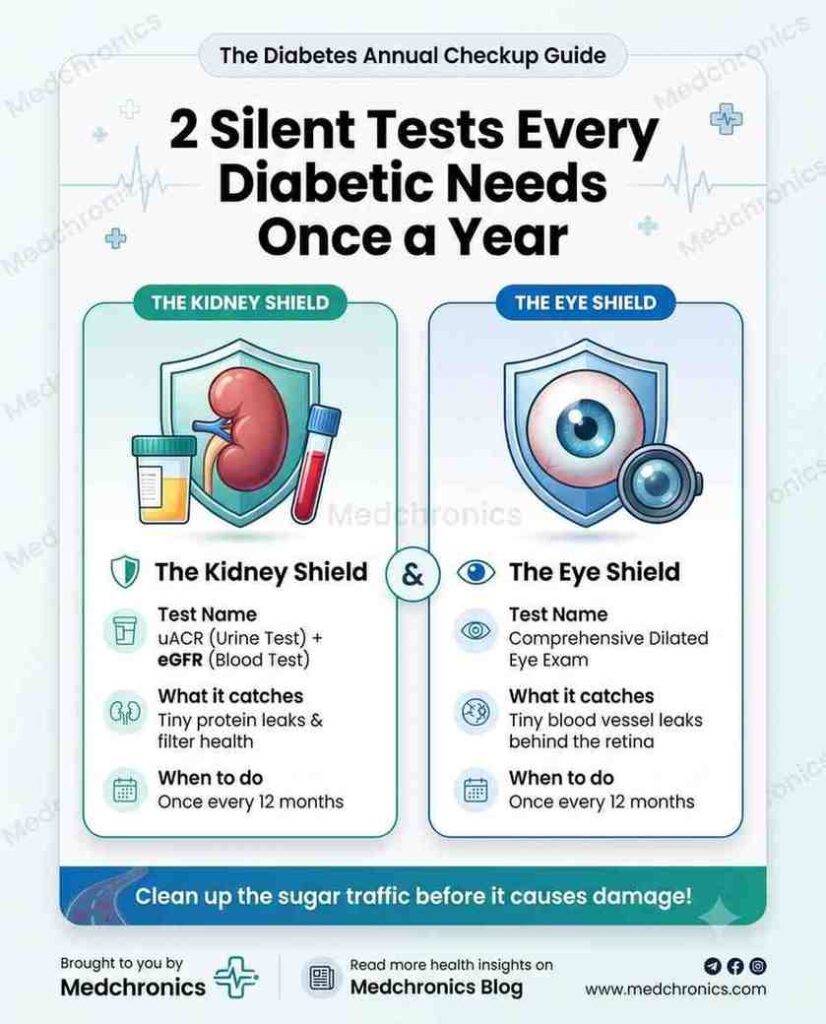
The best part of this story is that you do not have to sit around and wait for your body city to break down. Even though these complications start silently without causing any pain, you can protect your organs using a “Secret Shield“—Yearly Screening.
Instead of waiting for visible symptoms to appear in your daily life, make sure to get these two simple, painless medical checks done once every year:

For the Kidneys: A simple urine test called uACR (Urine Albumin-to-Creatinine Ratio) and a quick blood test called eGFR (estimated Glomerular Filtration Rate). Together, they can detect tiny, microscopic protein leaks and filter slowdowns years before any foam ever appears in the toilet bowl.
For the Eyes: A doctor can perform a Comprehensive Dilated Eye Exam. By using special eye drops to widen your pupil, they can look directly inside your eye to check if the fairy lights and tiny blood vessels are safe long before your vision starts to blur.
In diabetic organ damage by keeping a close eye on these 5 critical warning signs and using your secret shield regularly, you can easily clear out the extra sugar traffic, protect your water factory and camera lenses, and maintain your amazing body city’s smooth operation for a very long time!
Frequently Asked Questions
Q. What are the first signs of diabetes affecting your kidneys?
In diabetic organ damage, the earliest signs of diabetic kidney damage are often silent, but the first noticeable warnings include unusually foamy or bubbly urine (which means protein is leaking out) and mild swelling around your eyes, feet, or ankles in the morning, as the body struggles to clear out excess fluid and salt.
Q. Can diabetic organ damage happen without any pain?
Yes, diabetic organ damage is often called “silent damage” because chronic high blood sugar destroys microscopic blood vessels slowly over time. Severe nerve, kidney, and eye damage can progress significantly without causing a single drop of pain, which is why regular screening is critical.
Q. What causes temporary blurry vision in people with diabetes?
In diabetic organ damage, temporary blurry vision that comes and goes is usually caused by fluctuating blood sugar levels. When your blood sugar shoots up, it pulls water into the lens of your eye, causing it to swell like a sponge and distort your focus. Once your sugar levels stabilize, the lens shrinks, and your vision returns to normal.
Q. What is a uACR test, and how often should a diabetic get it?
A uACR (Urine Albumin-to-Creatinine Ratio) test is a simple urine checkup that detects microscopic protein leaks years before any physical symptoms show up. Anyone managing diabetes should get a uACR test along with a blood eGFR test at least once every 12 months to shield their kidneys.
Q. Why do some diabetic patients experience a metallic taste in their mouth?
In diabetic organ damage, a persistent metallic or bitter taste combined with extreme fatigue can happen when advanced kidney damage slows down the body’s filtration system. When the kidneys fail to clear out waste, toxins build up in the bloodstream (a condition called uremia), causing a metallic flavor in the mouth.