
When you see someone whose hand is shaking, you might instantly think, “Oh, that must be Parkinson’s disease.” While that can be true, there is a much bigger story here.
Parkinson’s is not just about shaking hands. It affects the whole body in different ways, and it looks unique for every single person.
Let’s break down how this condition works using simple terms. We will skip the confusing medical textbook language so you can truly understand it.
Table of Contents
Looking at Parkinson’s in a New Way
Learning about a medical condition can feel scary, but knowing the facts can replace that fear with hope.
Shaking Up the Stereotypes
When we see Parkinson’s in movies, it usually shows an older person shaking a lot. But this picture is way too simple.
The condition can affect younger adults, too, and many people with Parkinson’s do not experience shaking at all. By looking at the bigger picture, we can learn how to give better support to those who need it.
Why This Guide is For Everyone
You do not need to be a doctor to understand how the human body works. We are going to avoid confusing words and long, boring lectures.
Instead, we will look at real-life signs, simple facts, and the amazing progress scientists are making right now.
What’s Actually Happening Inside the Brain?
To understand how Parkinson’s affects movement, we need to take a quick peek inside the brain. At its core, this condition is just a case of missing messages.
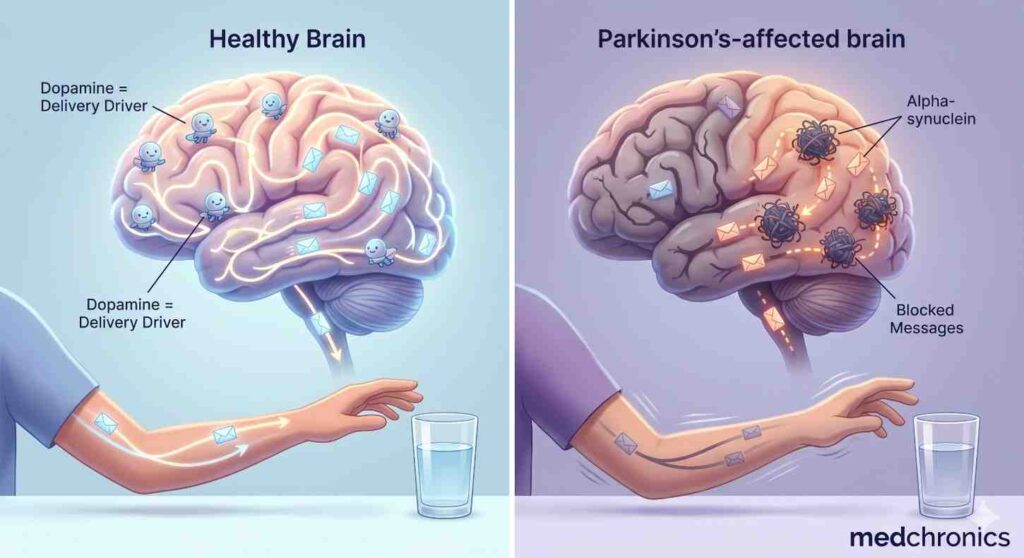
Meet Dopamine: Your Brain’s Delivery Driver
Think of your brain as a busy control center. To make your arms and legs move smoothly, the brain uses a special chemical called dopamine.
You can think of dopamine as a delivery driver carrying messages to your muscles. If you want to grab a glass of water, dopamine delivers that message perfectly so your arm moves fluidly.
The Problem with Missing Messages
In a person with Parkinson’s, the brain cells that make dopamine start to wear out. Without enough dopamine drivers, the movement messages get lost or delayed.
This is why movements can become slow or stiff. Scientists have also found that a protein called alpha-synuclein clumps together like trash in the brain, blocking the pathways.
Spotting the Signs: It’s More Than Just Shaking
Because Parkinson’s develops very slowly, the earliest signs are often quiet changes that are easy to miss.
The Four Main Movement Signs
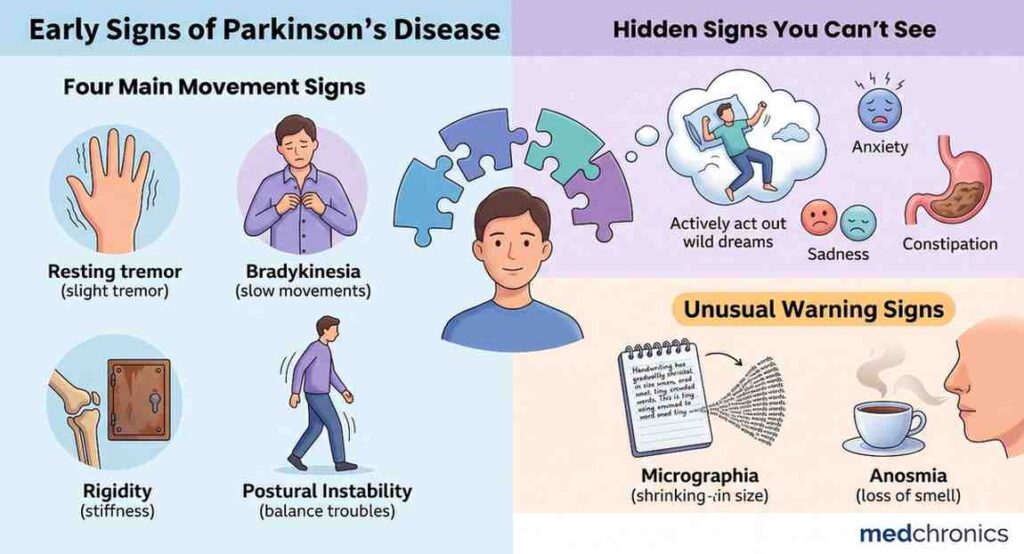
Doctors usually look for four physical changes when checking for the condition:
- Tremors: Shaking that happens when a hand, finger, or foot is completely relaxed.
- Slow Movements: Everyday tasks like tying shoes or buttoning a shirt take a lot longer than usual.
- Stiffness: Muscles feel tight and hard to bend, almost like a rusty door hinge.
- Balance Troubles: Feeling unsteady on your feet, which can lead to accidental trips.
The Hidden Signs You Can’t See
Parkinson’s also causes changes that do not show up on the outside. These are called non-motor symptoms.
People might face trouble sleeping, like acting out wild dreams at night. Others might struggle with feeling very anxious, sad, or dealing with frequent stomach issues like constipation.
Tiny Handwriting and the Lost Sense of Smell
Two early warning signs are very strange but easy to overlook. The first is micrographia, which means your handwriting suddenly becomes super tiny and crowded together.
The second sign is losing your sense of smell. If you suddenly can no longer smell your morning coffee or favorite foods, it might be an early clue.
What Causes Parkinson’s Disease?
The most common question people ask is simple: “Why did this happen?” The answer is a mix of genes, environment, and biology.
Is it in Your Genes?
The fact that Parkinson’s disease always runs in families is a prevalent concern. Usually, the answer is no.
Only a very small number of cases are strictly hereditary. Most of the time, the condition happens on its own without a direct family link.
Things in Our Environment
Scientists think that our surroundings play a role too. Being around strong chemicals like certain farming weed killers or industrial metals for a very long time might raise a person’s risk.
The Surprising Gut Connection
Here is an amazing fact: your gut and your brain talk to each other all the time.
New research shows that the early stages of Parkinson’s might actually start in the stomach or intestines before traveling up a long nerve to the brain.
How Do Doctors Know It Is Parkinson’s?
Finding out if someone has Parkinson’s requires patience, careful observation, and a specialist’s eye.
No Simple Tests Available
Right now, there is no single blood test or quick scan that can instantly say, “Yes, this is Parkinson’s.” Doctors have to act like detectives to figure it out.
The Neurologist Visit
A neurologist is a doctor who specializes in the brain and nerves. They will watch you walk, ask you to tap your fingers quickly, and ask a lot of questions about your daily habits to see how your body behaves.
Special Brain Scans
Sometimes, doctors use a special brain scan called a DaTscan. This scan takes a clear picture of the dopamine system to see if cells are missing. Doctors are also creating quick skin tests to find the condition sooner.
The Treatment Toolkit: How People Get Better
While there is no final cure yet, the modern tools used to manage symptoms and keep life fun and active are better than ever.
Reliable Medications
The most common treatment is a pill called carbidopa-levodopa. Think of this pill as a refuel station for your brain.
Once swallowed, it turns directly into dopamine. This helps the brain send smooth messages to your muscles again and stops a lot of the stiffness.
High-Tech Brain Devices
For advanced cases, doctors can use Deep Brain Stimulation. This works like a pacemaker for the brain.
A tiny, safe device sends soft electrical pulses to block the chaotic brain signals that cause severe shaking.
Using Sound Waves Instead of Surgery
There is a newer option called focused ultrasound. Doctors use targeted sound waves to fix the area of the brain causing the tremors.
The best part? No cuts or traditional surgery are needed, and the shaking can stop on the exact same day.
Living Your Best Life Every Day
Medical treatments are essential, but daily lifestyle choices made at home play an equally massive role.
Exercise is Medicine
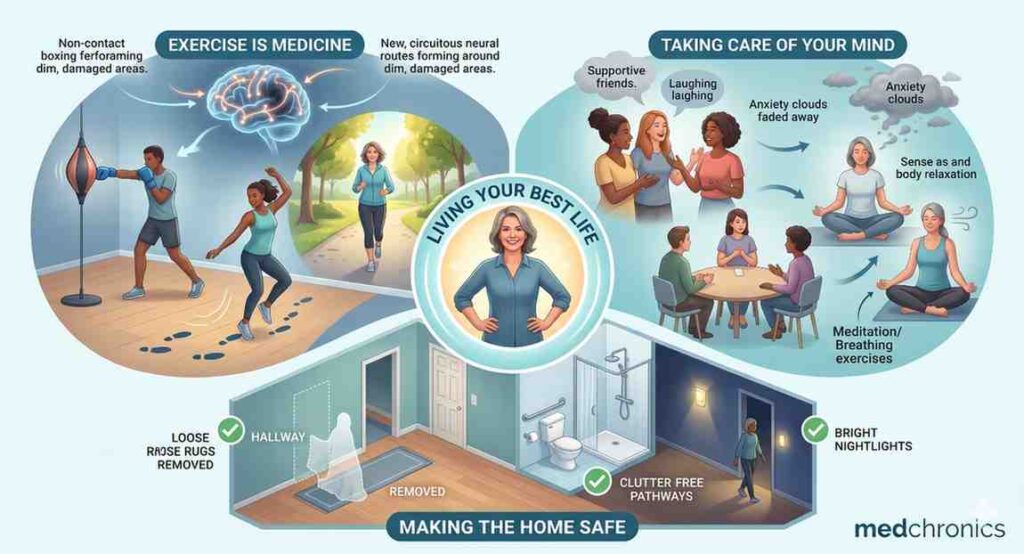
Moving your body is just as important as taking pills. Fun exercises help the brain build new paths around the damaged parts.
Activities that challenge your rhythm—like non-contact boxing classes, dancing, or brisk walks—are incredibly effective at fighting off muscle stiffness.
Taking Care of Your Mind
Physical tremors can appear and feel much more severe when one is anxious or afraid. Joining support groups, talking to friends, and practicing simple relaxation can help keep the body calm.
Making the Home Safe
A few small changes around the house can prevent dangerous falls and build confidence.
- Remove slippery throw rugs from the floor.
- Put strong, secure handrails in the bathroom and shower.
- Keep walkways completely clear of clutter.
- Use bright nightlights in hallways for midnight bathroom trips.
New Research & Breakthroughs
The scientific community is moving faster than ever to transform how we treat this condition.
- New Blood Tests: Researchers are validating simple blood tests that can spot Parkinson’s years before any shaking starts, letting people get help early.
- Growing New Cells: Doctors are working on ways to grow healthy new dopamine cells in labs to safely replace the old, worn-out cells in the brain.
- Faster Global Trials: New global trial networks are testing multiple existing medicines at the exact same time, cutting years off the search for a cure.